(Global Infinity Labs) – Four new deep-water berths broke ground at Lach Huyen on November 23, a project of 24.845 trillion dong designed for 4.7 million TEU a year, while terminals across the southern complex spent the same week working down vessel queues that stretch past three and a half days. For a factory manager deciding which coast to truck a container to, the two ends of the export system are now pulling in different directions: the north is adding quay, the south is rationing it.
What broke ground on 23 November
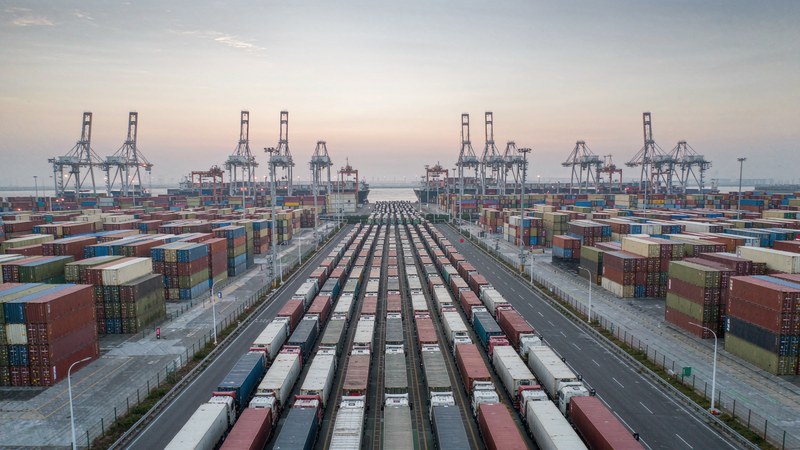
The ceremony covered berths 9 through 12 in the Lach Huyen port area, invested by Lach Huyen Port Investment JSC across roughly 146.2 hectares of land and water surface. The four berths carry a combined main quay of 1,800 meters, a 400-meter barge berth, container yards and repair workshops, and are designed to receive container ships of 12,000 to 18,000 TEU. State news agency coverage and the port city’s own newspaper put total port investment at 24.845 trillion dong, positioned as a green international container terminal, and a companion factory for high-purity rare-earth materials worth about 1.58 trillion dong brought the day’s combined figure to roughly 26.4 trillion dong. Neither project has a published completion date.
The most useful detail for shippers came from the municipal government side of the ceremony. Le Anh Quan, standing vice chairman of the city People’s Committee, said the six existing deep-water berths at the complex already operate in coordination, with more than 2.4 kilometers of quay and over 170 hectares of cargo yards. Direct shipping routes to Europe and the Americas are running, and the port can take container ships of nearly 214,000 deadweight tonnes. In other words, the groundbreaking adds headroom to a system that already operates at scale; it does not build a gateway from zero.
The inland math that decides the port
Inland trucking is priced by the kilometer and road quality varies widely, so the cheapest gateway is usually the nearest one. Forwarder guidance published this year puts a 40-foot container move from Hai Duong province to the northern deep-water complex at roughly USD 80 to 150, while the same box from Binh Duong down to the southern deep-sea terminals runs USD 100 to 200. Those figures are directional estimates to be re-quoted live, but the pattern behind them is stable, and it is a pattern about geography before it is a pattern about freight rates.
Rerouting northern cargo to the southern coast is the expensive option by design: more than 1,700 kilometers of extra trucking, roughly USD 900 to 1,300 per container, and two to three days of transit that the production calendar rarely has to spare. The northern industrial belt around Bac Ninh and Hung Yen sits 60 to 120 kilometers from its own gateway, an easy same-day move. That distance, not the ocean rate, is what anchors most factory-port pairings in the first place.
There is also a pressure valve between the two systems. Domestic coastal services move containers from the northern gateway to the southern one in 48 to 60 hours port to port, at a per-ton cost that one operator puts 40 to 55 percent below the Route 1A highway trunk, with door-to-door transit of four to five business days. That valve depends on feeder space, and feeder space tightens sharply ahead of holidays and peak export cycles.
Where the boxes wait this week
The southern complex is the one under strain right now. A weekly operational review by a global freight forwarder covering November 18 to 24 put the seven-day average vessel waiting time at Cai Mep International Terminal around 3.5 days, with Gemalink congested at roughly two days and up to four days for vessels arriving outside their berth window. Yard utilisation at the affected terminals has stayed above 90 percent, which is the kind of density that slows every move on the quay, not just the ones behind the queue.
Throughput records underline the same point. Tan Cang-Cai Mep International Terminal, a member of Saigon Newport Corporation, handled its two millionth TEU of 2026 on November 4, twenty days earlier than it reached the same mark in 2025 and the fourth time it has crossed that threshold in its operating history. In November the Vietnam Seaports Association carried a member notice that SP-SSA International Terminal welcomed MSC’s new Zephyr service, a direct connection to the Middle East inaugurated by a 16,196-TEU vessel, at a terminal rated for ships up to 24,000 TEU. Demand at the southern complex keeps arriving even while the berths work through their queues.
What the northern buildout changes
For northern shippers, the groundbreaking is about headroom and vessel class. The new berths are designed for 12,000 to 18,000 TEU ships, sizes that today mostly favor the southern deep-water complex, and the 400-meter barge berth signals more feeder and barge connections, beyond truck-gate arrivals alone. Extra quay on top of the existing 170 hectares of yard space gives shipping lines room to add loops without squeezing yard density, and yard density is precisely the variable that tends to push cutoffs tighter.
The operating discipline at the northern gates is already digitized. Field clerks register electronic equipment receipts through the e-Port system at the terminal gate, and periodic roadside inspections of container trucks check for VAT invoices or internal transfer notes accompanying domestic moves. None of that makes headlines, but together these small frictions decide how reliably a loaded truck actually makes its closing time.
What stays true at the southern end
Nothing in the northern groundbreaking changes the southern complex’s core advantages. It remains the place where 24,000-TEU ships can be worked and where new long-haul services keep being added, as the Zephyr launch shows. Congestion readings this high are operational states, not structural verdicts: berth windows, yard density and vessel bunching move up and down through the year, and carriers re-time their loops in response. A terminal that clears queues in one quarter can post record throughput in the next.
The southern hinterland logic holds as well. Factories across the southern industrial belt sit 20 to 60 kilometers from their own gateway cluster, and the trucking rates to reach it sit in the same band as the northern numbers. A plant in Binh Duong or Dong Nai does not reroute because the north added berths. It reroutes only when cutoffs, rates or capacity on its own coast fail it, and none of the November data suggests that has happened yet.
The routing rule that survives both projects
The durable rule is to price the door, not the berth. Ocean freight is only the visible half of the landed cost; the truck leg, the cutoff risk and the free-time terms decide whether a cheap port-to-port rate is cheap at all. Forwarders make the same point with arithmetic: a container that misses its terminal cutoff waits for the next sailing loop, and a missed loop can mean a missed deep-sea departure, which costs more than any inland leg ever saves.
For the next few quarters the practical checklist looks the same on both coasts. Confirm the terminal and its published cutoff before booking, not after. Reserve coastal feeder space three to four days ahead around holidays, when space tightens fastest. Compare door-to-door quotes whenever the factory sits anywhere between the two systems, because the inland leg flips the ranking more often than the ocean rate does. And treat the new berths as future capacity: with no completion date published, the berths that work today are still the ones that set the cutoff that matters.
Sources
- VietnamPlus (VNA)
 , “PM attends groundbreaking of 1 bln USD port and high-tech materials projects in Hai Phong”, November 23, 2026.
- Hai Phong Newspaper , “Prime Minister Le Minh Hung attends groundbreaking ceremonies for two major projects in Hai Phong”, November 23, 2026.
- Kuehne+Nagel , “Port operational updates from around the world (18 Nov – 24 Nov 2026)”, November 24, 2026.
- Tan Cang-Cai Mep International Terminal (TCIT) , “TCIT reaches 2 million TEU milestone in record time since operations”, November 4, 2026.
- Vietnam Seaports Association (VPA) , “SSIT welcomes ZEPHYR, expanding Vietnam-Middle East connectivity”, November 2026.
- VNForwarder , “Ho Chi Minh City vs Hai Phong: Which Port Is Best for Your Cargo?”, 2026.
- Vietship , “Reliable domestic sea freight from Haiphong Port to Cai Mep – Thi Vai”, 2026.
This article was prepared by the expert team at Global Infinity Labs, drawing on insights and data provided through its MCP data services.
About Global Infinity Labs
Global Infinity Labs is an AI innovation company specializing in MCP data services.
To share industry insights, report corrections, or submit story tips: editors@globalinfinitylabs.com or https://www.globalinfinitylabs.com/submit.
source https://newsroom.seaprwire.com/press-releases/logistics/hai-phong-expansion-and-cai-mep-congestion-reshape-inland-costs/